A message regarding potential network disruption for patients with Aetna insurance.

Providing Hope through Award-winning Care
Stroke can cause a range of disabilities – from problems walking and balancing to memory disturbances and even paralysis – but thanks to advances in treatment and rehabilitation, the outlook for stroke patients today is more hopeful than ever before.
At Baptist Health, our physicians and staff work as an interdisciplinary team, partnering with patients and their families to provide the best possible care. Through a range of progressive services, we help patients return to their communities, while also helping their families adjust to their diagnosis and any permanent impairments.
Our Mission
In support of our hospital mission, the Stroke Program is committed to improving stroke care and prevention by:
- Providing exemplary clinical care
- Educating staff and patients on stroke recognition, timely treatment and prevention
- Extending our program to provide community education
The Highest Standard of Care
We work to provide each patient with the latest, most effective treatment–a commitment that has earned Baptist Health Stroke Certifications from the DNV, and The Joint Commission for advanced quality care.
Advanced Comprehensive Stroke Center certification designates hospitals with advanced technology, infrastructure, staff and training to receive and treat patients of all ages with all types of strokes. In addition to being prepared to treat all types of strokes quicker than non-certified hospitals, we offer:
- 24/7 stroke team access
- Advanced imaging technology and protocols
- Advanced treatment options including thrombolytics and minimally invasive surgery
- Seamless integration with the ER
- A multidisciplinary approach including therapy, pastoral care, and rehabilitation experts
In addition to Joint Commission certification, each hospital has also received additional awards. Both Baptist Health-Little Rock and Baptist Health-Fort Smith have been given the Get With the Guidelines-Stroke Gold Plus Achievement Award by the American Heart Association and American Stroke Association, while Baptist Health-Fort Smith has also been named a “Top Stroke Center” by the American Heart Association.
Recognizing a Stroke
- Weakness or numbness of the face, arm, or leg, especially on one side of the body
- Confusion or difficulty speaking or understanding
- Problems with vision such as dimness or loss of vision in one or both eyes
- Dizziness or problems with balance or coordination
- Problems with movement or walking
- Severe headaches with no other known cause
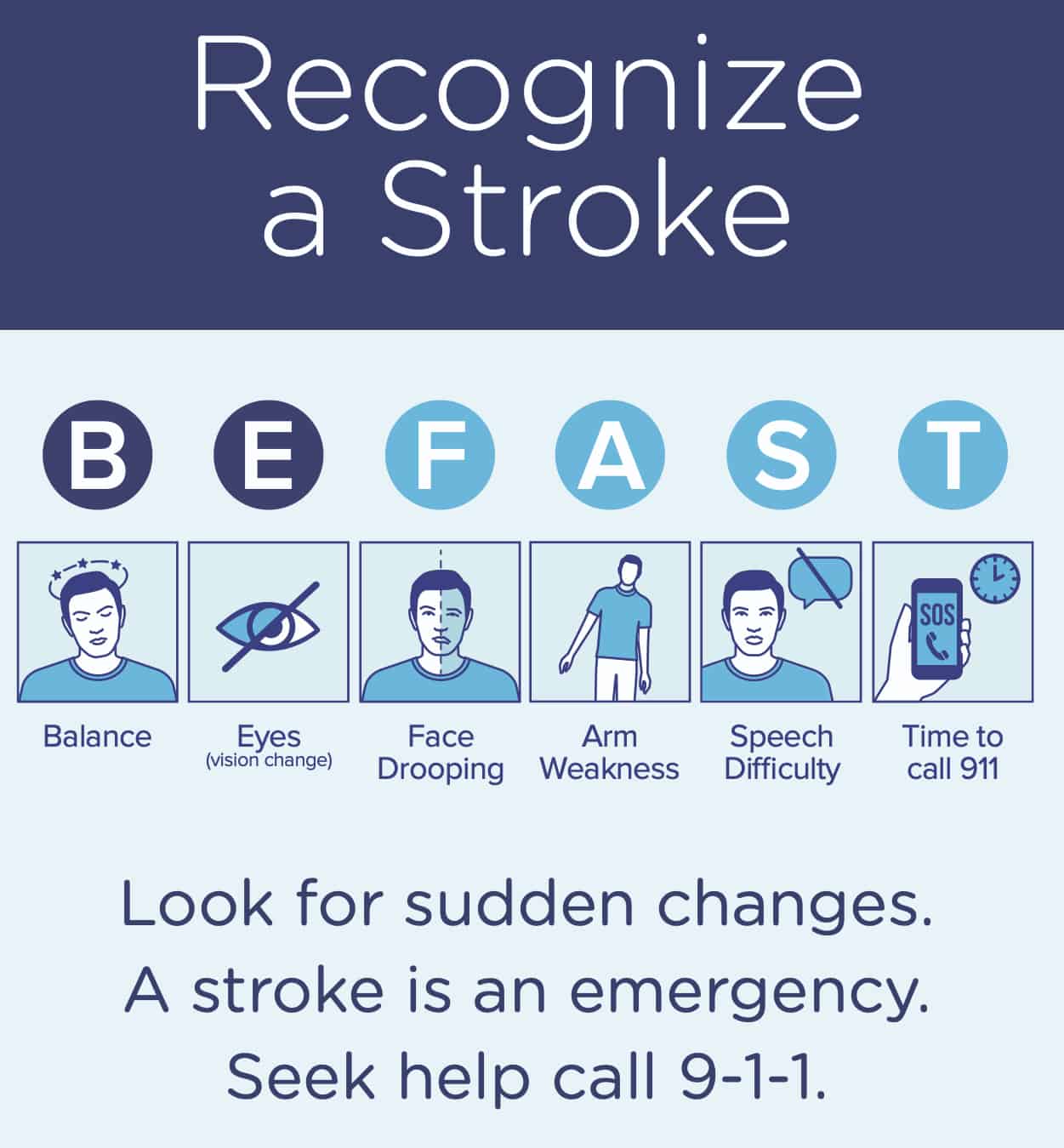
Remember, BE FAST
BE FAST is an easy way to remember the sudden signs of stroke. When you can spot the signs, you’ll know when you need to call 9-1-1 for help. The sooner the person having a stroke receives medical care, the better their chances of survival and recovery will be.
BE FAST stands for:
Balance – Is there a sudden loss of balance or coordination?
Eyes – Is there double vision or sudden loss of vision in one or both eyes?
Face Drooping – Does one side of the face droop or is it numb? Ask the person to smile. Is the person’s smile uneven?
Arm Weakness – Is one arm weak or numb? Ask the person to raise both arms. Does one arm drift downward?
Speech Difficulty – Is speech slurred? Is the person unable to speak or hard to understand? Ask the person to repeat a simple sentence, like “The sky is blue.” Is the sentence repeated correctly?
Time to call 9-1-1 – If someone shows any of these symptoms, even if the symptoms go away, call 9-1-1 and get the person to the hospital immediately. Check the time so you’ll know when the first symptoms appeared.

In the News
Health Matters: Baptist Health in Little Rock using new device to treat brain aneurysms
LITTLE ROCK, Ark.- Baptist Health in Little Rock recently became the first hospital to use a new device to treat brain aneurysms.
'Time is everything': Doctors use new treatment to help stroke victims
LITTLE ROCK, Ark. (KATV) - Friday is World Stroke Day. The campaign aims to raise awareness about strike risks and prevention.
“BEFAST about Stroke! “
Watch the video below to learn more.
Are You at Risk for Stroke?
Answering the following questions can help you learn more about your risk for stroke.